
Black Friday 2025 vs 2026: what still matters, one month out
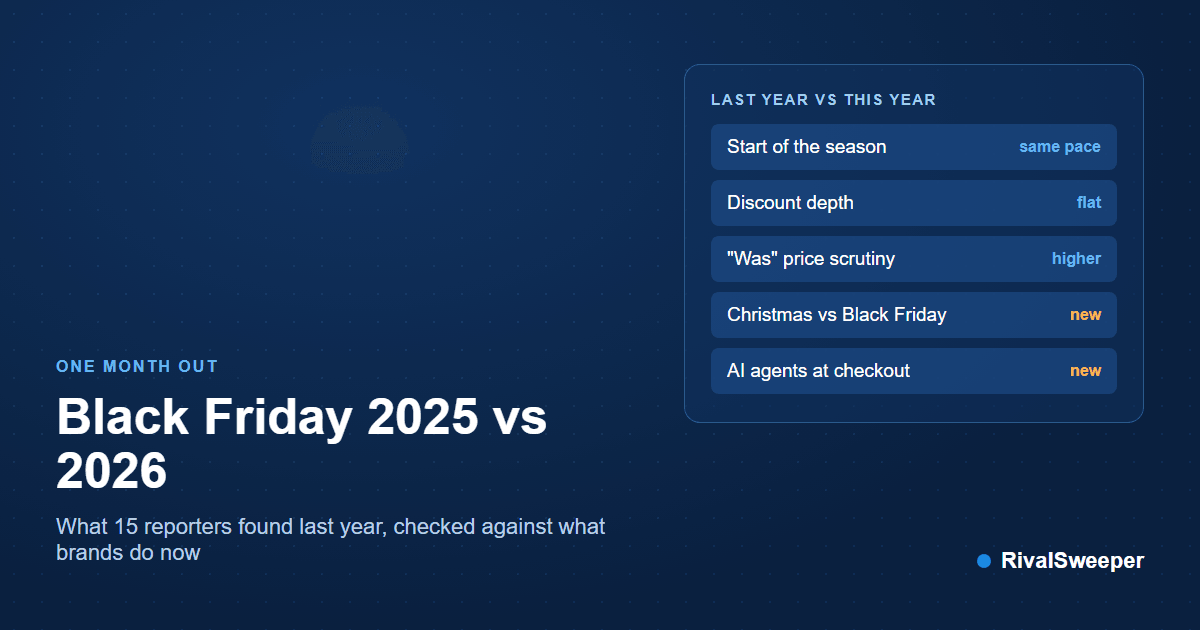
Black Friday 2026 is Friday, November 27, one month from now. Last season, 15 reporters at 12 outlets each measured a different piece of Black Friday 2025, and each is credited and linked below. The useful question now is which of their findings still hold. So we checked each one against what the independent brands RivalSweeper tracks were doing in the week to October 23, and against what retailers, forecasters and regulators have published for 2026. Two lessons hold exactly, one matters more than it did, and two things are new.
Updated every week until Cyber Monday: our Black Friday 2026 Rival Watch shows when brands start, channel by channel, compared with the week before.
2025 vs 2026 at a glance
| Question | Black Friday 2025: what reporters found | One month before Black Friday 2026: what we see | Still relevant? |
|---|---|---|---|
| When does it start? | Big retailers pitched sales from late October; promotion-driven revenue rose from mid-November | Same pace: 2 of 68 brands had a Black Friday ad live 35 days out, in both years | Yes. Expect the jump in the last three weeks |
| How deep? | Flat, or slightly smaller | Forecasts say flat; 41 of 179 brands already show a %-off offer, median headline 30% | Yes. The percentage won't set a brand apart |
| Do shoppers trust the "was" price? | 84% suspect prices go up before a sale | Regulators have made discount claims a priority; the 30-day window for November 27 opens October 28 | More than last year |
| What comes first? | Not covered | Christmas: 44 Christmas ads vs 14 Black Friday ads in the week to October 23 | New for 2026 |
| Who buys? | AI assistants sent 693% more traffic, from a small base | AI agents can now check out on the shopper's behalf | New for 2026 |
1. When does Black Friday start? Same pace as last year

What reporters found in 2025
Kristina Monllos, Marketing Brew, asked whether "Black November" is a problem, with big retailers pitching preliminary sales from late October, and one agency CEO she interviewed saying brands focused on margin may keep their sale windows shorter. (Marketing Brew, Nov 25, 2025)
Emily Manock, Marketing Week, reported Talon.One data showing promotion-driven revenue rising from November 16, a week earlier than in 2024. (Marketing Week, Dec 8, 2025)
Hayley Guest, Retail Gazette, reported the British Retail Consortium's view that Black Friday deals began earlier than usual, and that UK non-food prices fell 0.6% year over year in November. (Retail Gazette, Dec 2, 2025)
Lexy Lebsack, Glossy, logged the October holiday-sales kickoff in beauty, seven weeks before Black Friday: most promotions on Amazon, Walmart and Target sat at 20% to 30% off, with a few hair care brands at 40%. (Glossy, Oct 7, 2025)
What we see one month out
- The same quiet start. We follow 68 brands that advertised on Facebook and Instagram in both seasons. 35 days before Black Friday, 2 of them had a Black Friday or Cyber Monday ad running, in 2026 exactly as in 2025. Last year that number went to 8 three weeks out, 19 one week out and 28 by Black Friday.
- The same early movers, on the same dates. A mid-size beauty brand opened a password-only Cyber Monday early-access sale on October 14 last year. This year its "Cyber Monday early access, 40% off almost everything" ads have run since October 12, and it emailed a "Cyber Monday leak" on October 15.
- Last year's first mover is a month later. The home-decor retailer that ran the first Black Friday ad of 2025, a sign-up ad 70 days out, started this year's version 36 days out. A different European home-decor retailer took the early slot, with a sign-up ad running since September 30.
- Still almost nothing in other channels. Between October 17 and 23, 14 of 9,485 live Facebook and Instagram ads mentioned Black Friday or Cyber Monday, all from 3 brands. None of 95 marketing emails did, and none of the promo bars on 50 stores. 14 of 365 brands link a Black Friday page from their homepage, and none runs a Black Friday offer on it.
- The big retailers set dates again. Lowe's starts its Black Friday deals on October 29, four weeks out (Lowe's, Oct 8, 2026), and Target runs early Black Friday deals from November 5 to 7 (Target, Oct 21, 2026). Shoppers start early too: Deloitte expects 28% of holiday budgets to be spent by the end of October, the highest share in six years (Deloitte, Oct 15, 2026).
Still relevant? Yes. The early weeks look like last year's, so if 2026 follows 2025, most of these brands will move in the last three weeks: last year, 20 of the 28 started in that stretch. That is the stretch to watch rivals week by week, not the day itself.
2. How deep? Flat last year, flat in every forecast
What reporters found in 2025
Dani James, Retail Dive, put flat online discounts on the losers' list of Black Friday 2025. In the Adobe data she cited, electronics peaked at 29% on Black Friday (30.1% in 2024), toys at 30% and furniture held at 19%, and Salesforce had average discount rates peaking at 28% in the US. (Retail Dive, Nov 29, 2025)
Julia Waldow, Modern Retail, found brands trimming their Black Friday offers rather than deepening them. Caraa offered 25% off most of its selection, versus 30% off in 2024, and CommerceIQ data in her piece had third-quarter discounts down 1.7% year over year while prices rose 3.7%. (Modern Retail, Nov 24, 2025)
Sabina Weston, Drapers, reported a 40% average Black Friday discount across 57 retailers in Drapers' own deals tracker, while premium and luxury British brands kept to 20% to 25% off selected products. (Drapers, Dec 1, 2025)
Anna Hensel, Modern Retail, tracked how D2C brands adapted to a drawn-out Cyber Week, against Salesforce data showing US Black Friday sales up 3% to $18 billion, average prices up 7% and order volumes down 1%. One western-wear brand in her piece, with sales up 45% year over year heading into Black Friday, offered 20% sitewide plus one 40% doorbuster on two items. (Modern Retail, Dec 2, 2025)
One dataset went the other way: Talon.One's platform data in Emily Manock's column showed an average price cut of 25%, up from 21% in 2024 (Marketing Week). Klaviyo, meanwhile, reported discounts down 10% year over year across ecommerce, while the brands on its platform with the smallest discounts grew fastest, up 14% (Klaviyo, Dec 2, 2025).
What we see one month out
- Nobody plans to go deeper. Adobe forecasts 2026 discounts on par with 2025, peaking at up to 30% off during Cyber Week (Adobe, Sept 28, 2026), and 81% of 90 brand and retail professionals expect their discounts to stay about the same (Modern Retail+ Research, Oct 22, 2026).
- A fifth of brands are already on sale, just not for Black Friday. Between October 17 and 23, 41 of 179 brands we track (22.9%) showed a percent-off promotion on their homepage. The median headline was 30% (middle half: 20% to 50%), and only 7 used sitewide wording. Welcome and sign-up offers are not counted.
- Fashion runs deepest. 22 of 103 fashion brands showed an offer, with a median headline of 40%. In beauty it was 4 of 24 (median 22.5%), in jewelry 5 of 17 (median 30%).
Still relevant? Yes. If depth stays flat, and a typical headline is already 30% a month out, the percentage alone won't set a brand apart in November. Timing, the offer's clarity and whether shoppers believe it will.
3. Can shoppers trust the "was" price? It matters more this year
What reporters found in 2025
Sydney Lake, Fortune, reported a Lightspeed survey of 3,000 adults in the US and Canada: 84% believe retailers raise prices ahead of sales to make the discount look bigger. (Fortune, Nov 5, 2025)
Jaewon Kang, Bloomberg, found shoppers underwhelmed by deals and crowds. One shopper at a factory outlet near Philadelphia said higher list prices left little real discount: a sweater she wanted had gone from $125 to $170 in a year. (Bloomberg via Fortune, Nov 28, 2025)
Gabrielle Fonrouge, CNBC, reported "discount burnout" five weeks before Black Friday: in an AlixPartners survey of more than 9,000 US shoppers, the importance of price fell 13% year over year and 30% fewer people ranked finding the best deal as very important. (CNBC, Oct 22, 2025)
Danny Parisi, Glossy, showed fashion brands front-loading inventory and raising prices before a tariff-hit holiday, with Descartes data showing a rare dip in US imports from September to October. (Glossy, Nov 11, 2025)
Price trackers found the same gap. Which? tracked 175 products on Black Friday 2024 offers at 8 UK retailers from May 2024 to May 2025: every one was the same price or cheaper than its Black Friday price at another point in that year, and 83% matched or beat their sales-period price (Which?, Nov 25, 2025).
What we see one month out
- Regulators are now on it. Since April 6, 2025, the UK's CMA can fine a business up to 10% of global turnover without going to court first (CMA, Apr 7, 2025), and in April 2026 it told businesses that discount claims "must be true, accurate and not misleading" (CMA blog, Apr 17, 2026). Black Friday 2026 is the first since. Its guidance, CMA207, treats a countdown timer that quietly restarts as a misleading urgency claim (CMA207).
- In the EU, the clock starts on October 28. An announced price reduction must show the lowest price of at least the previous 30 days (Directive 2019/2161, Art. 2), and the EU Court of Justice ruled that the percentage must be calculated from that price (CJEU, C-330/23, Sept 26, 2024). For a discount shown on November 27, that window opens on October 28. In the US, the FTC's pricing guides expect a former price to be one the item was openly offered at for a reasonably substantial period (16 CFR 233.1), and UK trading standards guidance expects evidence of significant sales at the higher price (CTSI).
- "Was" prices are already everywhere. Across 80 stores whose product pages we read in the week to October 23, the typical store showed a "was" price on 13.6% of its products, with the current price a median 30% below it. In fashion it was 26.6% of products, at a median 43% below the "was" price (35 stores).
- Few of them come from a recent cut. Of 16 stores where we log every price change, 3 cut at least one price by 5% or more in that week from a price they had held for three days or more. At those stores, almost all of the "was" prices shoppers saw were set before that week, which is exactly what a shopper, or a regulator, will ask about in November.
Still relevant? More than last year. In 2025 the doubt was the shopper's. In 2026 it is also the regulator's, and the evidence for a November 27 "was" price is created over the next four weeks.
4. New in 2026: Christmas is ahead of Black Friday
Last year's coverage was about Black Friday creeping earlier. This year, a month out, the louder message in the brands we track is Christmas. Between October 17 and 23:
- Ads: 44 live Facebook and Instagram ads mentioned Christmas or holiday gifting, against 14 that mentioned Black Friday or Cyber Monday (each from 3 brands, out of 9,485 ads from 49 advertisers). One European home-decor retailer has run "Christmas before Christmas" advent calendar ads since mid-September.
- Emails and promo bars: 3 of 95 emails promoted a Christmas shop or holiday gifts, one with "up to 40% off" in its Christmas shop; none mentioned Black Friday. One store's promo bar pointed to Christmas; none to Black Friday.
- Homepages: 36 of 365 brands feature Christmas or holiday gifts on their homepage, more than twice the 14 that link a Black Friday page.
What it means: for gifting categories, the first purchase of the season may come from a Christmas edit, not a Black Friday code. A brand that only plans for November 27 may meet shoppers who already bought their gifts.
5. New in 2026: AI agents can now buy
What reporters found in 2025
Armando Roggio, Practical eCommerce, noted Adobe's 693% jump in AI-driven holiday traffic to ecommerce sites, while pointing out that AI still made up a tiny share of direct visits. (Practical eCommerce, Jan 11, 2026)
Emily Jensen, Glossy, found beauty shoppers balancing value with treating themselves, citing Adobe's $11.8 billion in US online Black Friday spend and TikTok Shop's own report of $500 million in sales over the four days from Black Friday to Cyber Monday. (Glossy, Dec 8, 2025)
What we see one month out
In 2025, AI assistants mostly sent shoppers to stores. Since then they have started to check out. ChatGPT's Instant Checkout launched with Stripe in September 2025 (Stripe, Sept 29, 2025), Google added agentic checkout in November 2025 (Google, Nov 13, 2025) and the Universal Commerce Protocol in January 2026 (Google, Jan 11, 2026), and Shopify's Agentic Storefronts opened its merchants to AI channels (Shopify, Mar 24, 2026). Adobe expects AI traffic to retail sites to grow another 130% this holiday season (Adobe, Sept 28, 2026).
What it means: agents work from your product data, so the sale price, the regular price and the sale dates need to match in your feed, your structured data and your page. A "was" price that only exists on the page is a weaker offer to a machine than to a person.
The rest of last year's results
Amanda Vlietstra, Internet Retailing, reported that UK retail sales slipped 0.1% in November despite Black Friday, against forecasts of growth, even as Adobe counted a record £3.8 billion spent online over Cyber Weekend. (Internet Retailing, Dec 19, 2025)
And the data publishers' own numbers, each measuring something different:
| Source | What it measured | Black Friday 2025 finding |
|---|---|---|
| Adobe, Dec 2, 2025 and Jan 7, 2026 | US online spend, from visits to US retail sites | $11.8B on Black Friday (+9.1%). Season peak discounts: electronics 30.9% (30.1% in 2024), apparel 25.1% (23.2%), furniture 18.8% (19%) |
| Salesforce, Dec 5, 2025 | Modelled global and US sales from 1.5B+ shoppers | Black Friday $79B global (+6%), $18B US (+3%). AI and agents influenced 20% of Cyber Week orders |
| LSEG Lipper Alpha with Centric Market Intelligence, Nov 25, 2025 | US online retail, November to date (published before Black Friday) | 31% of products on sale, average discount 34% (35% in 2024) |
| Klaviyo, Dec 2, 2025 | eCommerce discounts, and sales of brands on its platform (a 10,000-brand cohort) | Discounts down 10% year over year across ecommerce; the brands with the smallest discounts grew 14% |
| Shopify, Dec 2, 2025 | Its merchants' sales worldwide, online and in store | $14.6B over Black Friday to Cyber Monday (+27%) |
| DataWeave, Dec 9, 2025 | About 80,000 products at large US retailers | Black Friday week added 1.5 to 3.8 points on top of discounts already running, depending on category |
| Talon.One, Dec 2, 2025 | Promotions run on its platform, about 300 brands | Average discount 25% (21% in 2024): US 35%, EMEA 24%, APAC 18% |
| Visualping, Nov 28, 2025 | 2,620 products at 9 retailers, monitored from October 1 | About a third of the products whose price changed were priced above their lowest price since October 1 on Black Friday |
What to do in the next four weeks
- This week: start the price log. October 28 opens the 30-day window behind a November 27 "was" price in the EU, and the same history shows UK and US regulators the price was real. Keep it for every product you plan to discount.
- Put the real "was" price on the page, and the same one in your feed. Shoppers already doubt it, regulators now check it, and AI agents read it from your product data.
- Decide your start date against the curve, not the calendar. Last year 20 of the 28 brands in our comparison started their Black Friday ads in the final three weeks, and 9 in the final week. Starting before that crowd is still possible in early November.
- Plan Christmas and Black Friday as one season. Gifting shoppers are being asked to buy for Christmas now. Decide which products carry the Christmas story and which carry the Black Friday offer.
- Start with your list, not your discount. Early access for subscribers and past customers is how last year's earliest movers began, and it doesn't need a sitewide markdown.
- Choose depth by margin and category, not by the loudest banner. A 30% headline is already common a month out; premium brands held at 20% to 25% last year, and the smallest discounters grew fastest.
- Click through every live ad, every week, until Cyber Monday. Retired pages and sold-out products cost the click and the sale.
- Make every deadline true, and plan the exit. If a countdown ends, the offer ends. When the sale ends, take the "was" prices and badges down with it.
- Watch your rivals week by week. By November 27 the decisions that matter are already made. Our guides to product feeds for AI shopping and last season's first movers go deeper.
Follow Black Friday 2026 week by week
Our Black Friday 2026 Rival Watch checks the brands we track every week until Cyber Monday: when they start, on which channel, and how their offers compare with the week before. The checks for October 1-8, 9-16 and 17-23 are there; this article's numbers are from the October 17-23 check.
How we measured
- Brands: the ecommerce brands RivalSweeper tracks, mostly independent D2C brands in fashion, beauty, jewelry and home across Europe, the US and Israel. Our customers' own stores are excluded. No brand is named.
- Channels, October 17-23, 2026: live Facebook and Instagram ads, marketing emails received, on-site promo bars and true homepages (pages whose own canonical address is the site's root), searched for Black Friday, Cyber Monday and BFCM, and separately for Christmas and holiday gifting terms. Every homepage match was read by hand. Google ads were not included because their text can't be read reliably.
- 68-brand comparison: brands that ran Facebook and Instagram ads in both the 2025 and 2026 seasons, counted by when their first Black Friday or Cyber Monday ad started, in days before Black Friday.
- Offers and "was" prices: percent-off promotions on homepages (welcome, sign-up, app and loyalty offers excluded; 41 of 43 flagged brands confirmed by hand), and "was" prices on product pages read in the week, in each store's home currency (106 of 109 sampled prices matched the live page). Verified cuts use stores where we log every price change for at least 30 days. No figure is shown for a group of fewer than 15 brands or stores.
Sources
The 15 reporters, in the order above:
- Kristina Monllos, "Is 'Black November' a problem?", Marketing Brew, Nov 25, 2025: marketingbrew.com
- Emily Manock, "Budget expectations, Black Friday, festive ads: 5 interesting stats to start your week", Marketing Week, Dec 8, 2025: marketingweek.com
- Hayley Guest, "Black Friday 'comes early', says BRC", Retail Gazette, Dec 2, 2025: retailgazette.co.uk
- Lexy Lebsack, "Beauty & Wellness Briefing: How brands are approaching this week's holiday sales kick-off, plus industry news", Glossy, Oct 7, 2025: glossy.co
- Dani James, "Winners and losers of Black Friday 2025", Retail Dive, Nov 29, 2025: retaildive.com
- Julia Waldow, "'You want to play defense': Amid economic pressure, brands usher in Black Friday by trimming deals", Modern Retail, Nov 24, 2025: modernretail.co
- Sabina Weston, "Black Friday spurs on sales", Drapers, Dec 1, 2025: drapersonline.com
- Anna Hensel, "Brands Briefing: Changing Cyber Week patterns and drawn-out sales force brands to shift strategies", Modern Retail, Dec 2, 2025: modernretail.co
- Sydney Lake, "Inflation is so bad Americans are counting on Black Friday just to afford groceries and everyday essentials", Fortune, Nov 5, 2025: fortune.com
- Jaewon Kang, "Shoppers are underwhelmed by deals and crowds on Black Friday", Bloomberg, republished by Fortune, Nov 28, 2025: fortune.com
- Gabrielle Fonrouge, "Consumers feeling 'discount burnout' ahead of Black Friday, Cyber Monday, survey finds", CNBC, Oct 22, 2025: cnbc.com
- Danny Parisi, "Front-loaded inventory, price increases and thinner margins: How brands are tackling a tariff-altered holiday season", Glossy, Nov 11, 2025: glossy.co
- Armando Roggio, "Early AI Signals from Holiday Sales", Practical eCommerce, Jan 11, 2026: practicalecommerce.com
- Emily Jensen, "Trust, treat culture and TikTok Shop: The beauty trends to watch for this holiday season", Glossy, Dec 8, 2025: glossy.co
- Amanda Vlietstra, "ONS figures show retail sales declined in November despite Black Friday boost", Internet Retailing, Dec 19, 2025: internetretailing.net
Data publishers, retailers, regulators and platforms are linked where they are cited above.
Editorial note: the summaries of each article are ours; please read the original reporting for full context. The reporters, outlets and data publishers named here have no affiliation with RivalSweeper and have not endorsed it. Brands in RivalSweeper's own data are not named.
AI transparency note: this article was drafted with AI assistance and reviewed by the RivalSweeper team, which holds editorial responsibility for it, in the spirit of EU AI Act Article 50.
RivalSweeper Briefings
Get our competitive-intel briefings
What is changing in ecommerce pricing, catalogs, and AI visibility, and what to do about it. A short read, no fluff.
Want us to run this on your store? Book 15 minutes.