
The competitor-watch routine, step by step, in retail teams' own words
What does the competitor-watch routine look like?
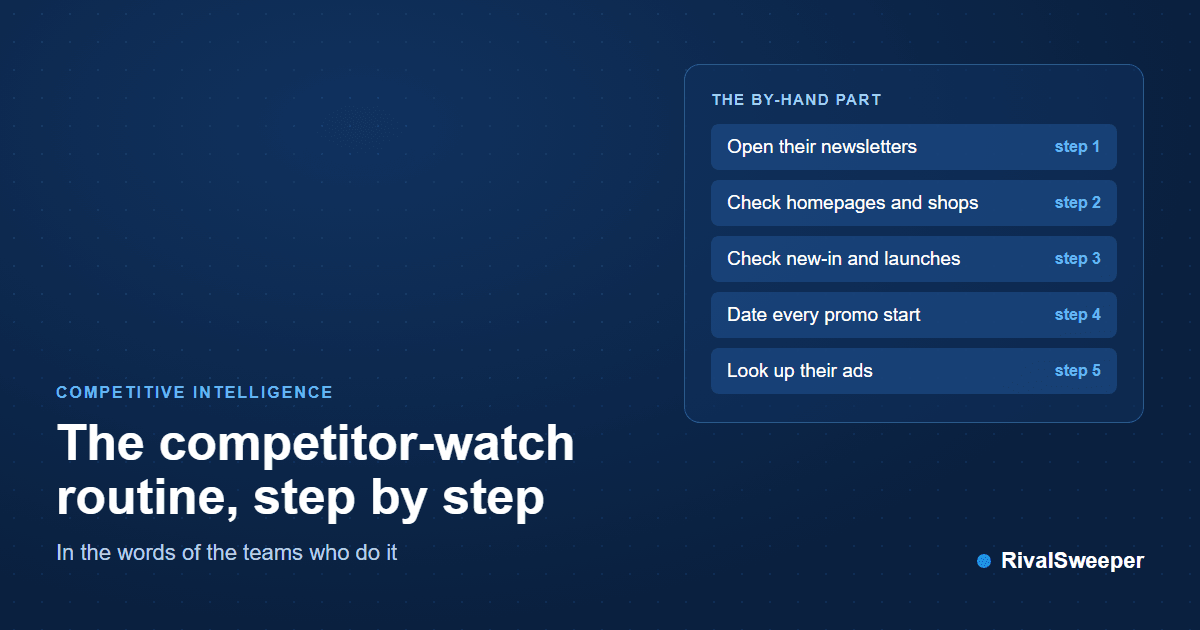
Six steps, often by hand: open rivals' newsletters, check their homepages and shops, check what is new in and launching, track when promotions start before peak weeks, look up their ads, and report it to the buying, marketing and promotions teams. Below, each step in the words of the people who do it, with a link next to every quote, and what RivalSweeper takes off the list.
A new store owner put the whole problem in one line on Reddit: "I don't really know what my competitors are doing in terms of: meta/google ads, discounts, new product launches, email campaigns." (r/AskMarketing, January 2026)
Bigger retailers have the same list. They solve it with a person, a calendar and a lot of screenshots. Notice what the list is made of: ads, discounts, launches and emails. Price isn't even on it. Discounts are one line of four.
Companies hire people to do this routine
Two job postings show the routine written down as a job. Both are closed now, and both read like a to-do list.
- Sephora, Manager, Business Intelligence & Analytics, Competitive (posted May 15, 2026, closed June 19, 2026): "Lead competitive intelligence initiatives by analyzing market share, pricing trends, promotional activity" and "Serve as a strategic thought partner to senior leadership, including Marketing, Loyalty, Promotions, and Opcom stakeholders". (career.com)
- Brilliant Earth, Merchant (posting removed November 12, 2025): "Conduct competitor reviews to monitor competitor's assortment, pricing, promotions and product introductions." (Built In Colorado)
Read the two lines side by side. Promotions appear in both. "Product introductions" sit next to pricing. And the work doesn't end at the analysis: it goes to Marketing, Loyalty and Promotions. That is the routine, and the rest of this post walks through it one step at a time.
About the quotes. Several of the quotes below come from customer stories published by the retail intelligence company EDITED, which sells competitive data to retailers. In them, retail teams describe what the work looked like by hand, what it would take without a tool, or what a tool changed. We quote them because they describe the manual routine in the teams' own words. Each quote links to its page.
Step 1: Open every rival's newsletter

The routine starts in an inbox. Someone signs up to each competitor's emails, then reads them. Anja Ulwer, in Market & Category Consulting at bonprix, described what it would take without a tool: they "would have to go into our email to see competitor newsletters or promotions," then "search for each competitor, take screenshots, and then go through every one manually." (EDITED customer story, bonprix)
Newsletters carry offers too, so this step is hard to skip. It is also easy to fall behind on in a busy week: the inbox fills up, and nobody notes which email came on which day.
What RivalSweeper does instead: RivalSweeper tracks your competitors' email newsletters, what they send their subscribers and when, so the record is kept whether or not anyone opened the inbox that week.
Step 2: Check the homepages and shops, country by country
Next come the homepages and shops: the hero banner, the promo bar, the message at the top. Before using a tool, bonprix checked rival shops country by country: "We had different people who manually checked the online shops of our main competitors across different countries". (EDITED customer story, bonprix)
The screenshot shows today. The question a buyer actually asks is about change: when did that banner go up, and what was there before? Without a tool, the same bonprix team said, they "would not have the opportunity to look at historical home pages or understand changes over time in just seconds." (same page)
What RivalSweeper does instead: RivalSweeper reads each competitor's homepage banners and marketing messages every day and keeps a dated history, which for a site RivalSweeper already monitors can go back before you sign up. The full list of what RivalSweeper tracks is on the product facts page.
Step 3: Check new-in and launches
Buyers watch rivals' "new in" pages to see what is launching and when. Monsoon's buying team, describing what tracking it with a tool gave them: "Tracking new-in across the market helped us understand what was launching, when, and how it was performing" (EDITED customer story, Monsoon)
At Cider, Lindsay Fiegleman, Executive Director of Strategic Merchandising and Trend, describes the same habit from the merchandising side: "I can frequently understand how other businesses interpret newness - whether that's in product, overall seasonal strategy…" (EDITED customer story, Cider)
By hand, this means scrolling each rival's new-in page and trying to remember what was there last week. The "when" in that Monsoon quote is the hard part: a page shows what is new now, not the day it arrived.
What RivalSweeper does instead: RivalSweeper checks each competitor's catalog every day and records new, removed and updated products and new categories, so a launch is known within 48 hours, with its date. More on the method in how to detect competitor product launches.
Step 4: Track when promotions start before peak weeks
Before Black Friday, the routine turns into a calendar. The question is "when?" as much as "how deep?". Lauren Masur, marketing director at Anyday, explained an early start as a way "to be on par with other brands that are also starting their promos well before Thanksgiving week." (Modern Retail, November 2024)
Vera Oh, co-founder and CEO of Voesh, saw the same shift a year later: "Economic uncertainty has led many brands to start discounting earlier and offer deeper promotions." (Beauty Independent, November 2025)
To know who started early, someone has to write down the day each rival's offer first appeared, across the site, the emails and the ads. Miss a day and the start date is a guess.
What RivalSweeper does instead: RivalSweeper records each competitor's promotions and coupon codes with the date it first saw them, and keeps its homepage banners, marketing messages, newsletters and ads dated too, so you can see where an offer showed up first. RivalSweeper alerts you in the app, Slack or Google Chat when a competitor starts a promotion. RivalSweeper's weekly Black Friday 2026 Rival Watch shows these start dates as they happen. RivalSweeper's move prediction, now rolling out, uses that tracked history to flag what a competitor is likely to do next, as an indication with a confidence level, never a certainty.
Step 5: Look up rivals' ads
Then the ad libraries. A store owner preparing for a first Black Friday described what that is like: "I've been scrolling through facebook ad library trying to see what bigger brands are doing but honestly it's overwhelming and I can't tell which ads are actually working vs just tests" (r/ecommerce, November 2025)
Some do it on a schedule. An advertiser on r/FacebookAds: "I track my competitors every week. They usually run 150-200 ads at a time. Right now, they are down to about 30" (r/FacebookAds, March 2026). That weekly count is the useful part, and it only exists if someone wrote last week's number down.
What RivalSweeper does instead: RivalSweeper tracks competitors' Meta ads, including ads that land on broken, sold-out or ended-offer pages, and their Google ads activity across Search, Shopping and YouTube. Some of RivalSweeper's Meta ad detail covers only ads shown in the EU or UK, where platforms have to publish them, so in RivalSweeper a brand that advertises only outside the EU and UK can show few or no Meta ads. To do this step by hand, start with how to see competitor Facebook ads.
Step 6: Report it to buying, marketing and promotions
The last step is the one the job postings stress. The Sephora role was to be "a strategic thought partner to senior leadership, including Marketing, Loyalty, Promotions, and Opcom stakeholders". (career.com) Monsoon's buying team says EDITED gives it "a clear picture of how competitors are positioning, pricing, and promoting," "especially during peak periods, which are critical to our overall trading performance." (EDITED customer story, Monsoon)
By hand, the report is a deck or an email built from steps 1 to 5. Laura Snell, Director of Visual Merchandising at Venus, put the time a tool saved on competitive research at "hours and days' worth of time". (EDITED customer story, Venus)
What RivalSweeper does instead: RivalSweeper shows the changes it finds on a dashboard and change feeds in the app, and RivalSweeper's change feeds can post to the Slack or Google Chat channel the buying or marketing team already reads (how to connect a feed to Slack). Teams that build their own reports can pull the same data through RivalSweeper's MCP server in an AI assistant such as Claude, or through the REST API on Pro and Enterprise plans.
The routine at a glance
| Step | By hand today | With RivalSweeper |
|---|---|---|
| 1. Newsletters | Sign up to every rival, search the inbox, screenshot | RivalSweeper records what each rival sends, and when |
| 2. Homepages | Check each shop, country by country, and screenshot | RivalSweeper reads banners and messages daily, with a dated history |
| 3. New-in and launches | Scroll new-in pages and remember last week | RivalSweeper logs new products and categories, known within 48 hours |
| 4. Promo start dates | Write down the day each offer appeared | RivalSweeper dates the promotions and coupon codes it finds, and alerts you |
| 5. Ads | Search the ad libraries, count by hand | RivalSweeper tracks Meta ads and Google ads activity |
| 6. Report | Build a deck or email from steps 1 to 5 | RivalSweeper feeds the changes to the app, Slack or Google Chat |
What stays with your team
Collecting is the chore. Deciding is the job. An anonymous head of marketing at a beauty brand warned that "if you get pulled into the comparison race, it is only ever a distraction from the fundamentals of the business." (Glossy, December 2023) The point of watching rivals is to know when to react and when to hold, with the evidence in front of you.
RivalSweeper does not make that call, and it does not reprice anything. RivalSweeper checks each competitor daily, not in real time, and reads public pages only. What RivalSweeper takes off the list is the collecting in steps 1 to 5, and what RivalSweeper leaves you is a dated record nobody had to screenshot. For why the manual version breaks as the competitor list grows, see the math of competitor monitoring, and for why price is only one signal of many, competitive intelligence beyond price monitoring.
Sources
- Sephora, Manager, Business Intelligence & Analytics, Competitive (posted May 15, 2026, closed June 19, 2026): career.com
- Brilliant Earth, Merchant (removed November 12, 2025): builtincolorado.com
- EDITED customer stories: bonprix, Monsoon, Cider, Venus (published May 2024 to March 2026, per page metadata)
- Modern Retail, DTC Briefing, November 5, 2024 (Anyday): modernretail.co
- Beauty Independent, November 18, 2025 (Voesh): beautyindependent.com
- Glossy, December 12, 2023 (anonymous beauty marketer): glossy.co
- Reddit: r/AskMarketing (January 28, 2026), r/ecommerce (November 18, 2025), r/FacebookAds (March 15, 2026)
- What RivalSweeper tracks, how often, and what it does not do: rivalsweeper.com/product-facts
AI transparency note: this article was drafted with AI assistance and reviewed by the RivalSweeper team, which holds editorial responsibility for it, in the spirit of EU AI Act Article 50. Quotes were checked against the linked pages on November 9, 2026. EDITED, Sephora, Brilliant Earth and the other companies quoted have no affiliation with RivalSweeper.
Frequently asked questions
What does a competitor monitoring routine look like in retail and ecommerce?
In the job postings, customer stories, trade-press interviews and Reddit threads RivalSweeper reviewed for this article, the routine has six steps: open rivals' newsletters, check their homepages and shops, check what is new in and launching, track when promotions start before peak weeks, look up their ads, and report it all to the buying, marketing and promotions teams. In those sources, much of it is done by hand.
Do retailers hire people to monitor competitors?
Yes. A Sephora posting for a Manager, Business Intelligence & Analytics, Competitive asked the hire to "Lead competitive intelligence initiatives by analyzing market share, pricing trends, promotional activity", and a Brilliant Earth Merchant posting asked for "competitor reviews to monitor competitor's assortment, pricing, promotions and product introductions." Both postings are now closed.
Can software replace manual competitor monitoring?
The collecting, yes. RivalSweeper checks each competitor's site every day and records its newsletters, homepage banners and marketing messages, new products and categories, promotions and coupon codes, and Meta and Google ads, with a dated history, and RivalSweeper shows the changes in the app or as feeds you can connect to Slack or Google Chat. Deciding whether to react stays with your team.
Free research report
Get the September 2026 Online Retail Radar
Anonymized September numbers from the stores we track: how many ran ads and how long the ads lasted, AI-agent readiness scores, payment methods and shipping carriers, and how new stores launched. We email you the link to the full report.
Prefer to skim first? Read the summary.