
How to set up competitor alerts your team still reads a month later
How do you set up competitor alerts for an online store?
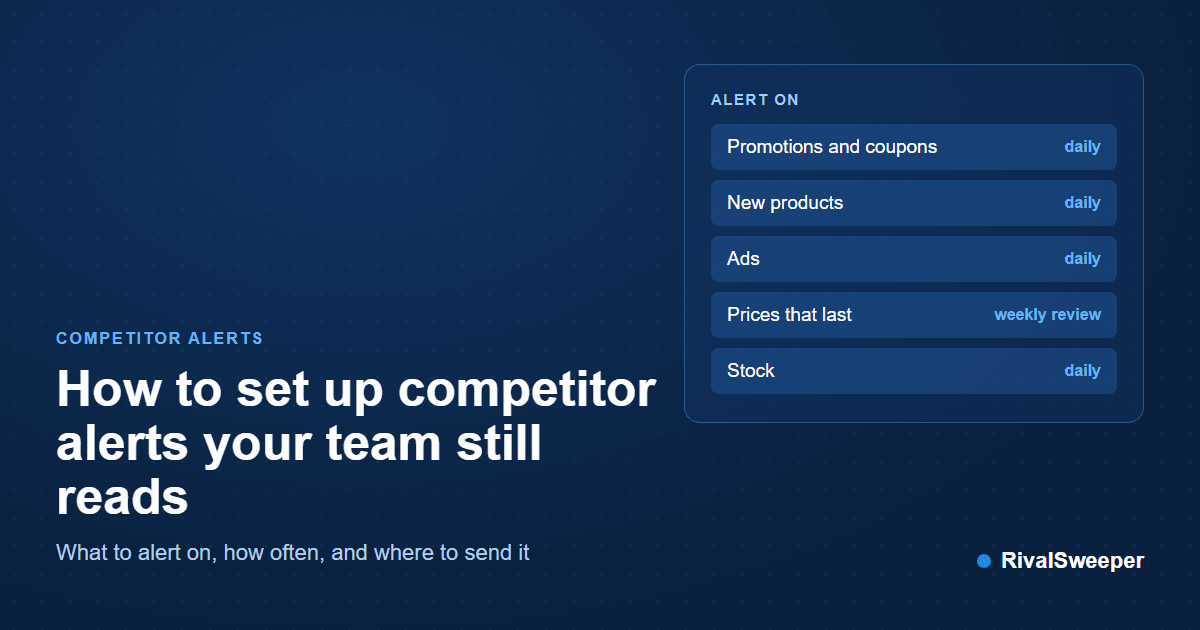
Pick the few competitor moves someone on your team would act on: a promotion starting, a new product or category, a new ad, and a price change that lasts on products you both sell. Check once a day, send the alerts to one channel the team already reads, group them into one line per competitor per day, and keep a dated history for everything else. Real-time only pays where software acts on the alert. Below: what to alert on, how often, which channel, why alerts get muted, and what RivalSweeper does and does not do.
Ask a store owner what they want to know about competitors and the list comes fast. One operator on r/ecommerce listed pricing changes, stock changes, new deals and promotions, new newsletters and new ad campaigns, then asked whether any tool covers all of it. (r/ecommerce, November 2025)
Getting alerts is the easy part. Still reading them a month later is the hard part. This guide is for the ecommerce marketing or pricing lead who has to set them up and then live with them.
An alert is something you act on
Teams that run on alerts for a living separate two things. PagerDuty's public incident guide says an alert is something a person has to act on, and that anything else is a notification. (PagerDuty, alerting principles) Google's site reliability handbook puts the rule in five words: "Every page should be actionable." (Google SRE book, chapter 6)
For a store, a rival starting a sitewide sale the week before yours is an alert. A rival fixing a typo on its returns page is a notification, and it belongs in a history you can search. Before you switch on any alert, answer three questions: who acts on it, what do they do, and by when. The same handbook asks of every alert whether the action is urgent or could wait until morning. (Google SRE book, chapter 6)
Watching competitors is already somebody's job

When the European Commission surveyed 1,051 online retailers for its ecommerce sector inquiry, 53% said they track competitors' online prices, and 67% of those used software to do it. The questionnaires date from 2015 and 2016, and the report from May 2017. (European Commission, SWD(2017) 154, paragraph 149)
The duty is written into job postings too. THG Ingenuity's posting for an eCommerce Trading Manager, open on November 19, 2026, lists monitoring competitor pricing, product ranges and promotional activity. (THG Ingenuity job posting) A Chewy posting for a Pricing Data Analyst, since removed, asked the hire to watch competitor activity and report changes in pricing and promotions, assortment and site functionality. (Built In Austin) Neither posting uses the word alert. The verbs are monitor, identify and communicate, which is the work an alert is meant to take over. For the by-hand version of that work, see the competitor-watch routine, step by step.
The five competitor alerts ecommerce teams ask for
Five kinds of competitor move are worth sorting, and they do not deserve the same alert. The reasoning and the source for each row follow the table.
| Competitor move | Alert on | How often | In RivalSweeper today |
|---|---|---|---|
| Promotions and coupons | A sale starts, gets deeper or ends; a new code; a new sign-up offer | Daily | In the app and in a change feed: coupons and discount codes, homepage banners, sign-up offers |
| New products and categories | A product or category is added or removed | Daily | In the app and in a change feed: products, categories |
| Ads | An ad starts or stops | Daily | In the app and in a change feed: Meta ads and Google ads |
| Prices | A change of about 5% or more that lasts two to three days, on a product you both sell | Daily check, weekly review | In the app, on supported websites, with a dated history. Not in the change feed or the email |
| Stock | A product you both sell goes out of stock or comes back | Daily | In the app, on supported websites. Not in the change feed or the email |
Promotions: a sequence, not one event
A sale is rarely one moment. Adobe's forecast for the 2026 US holiday season has top discounts stepping up from 14% in early November to 21% just before Thanksgiving and 30% in Cyber Week. (Adobe, September 2026) So the useful alerts are three: the promotion started, it got deeper, it ended.
Depth gives you a threshold. In a University at Buffalo survey of 2,011 US shoppers in fall 2025, 51% said they would move their main shopping to another store for a discount of 20% or less. (University at Buffalo, fall 2025) A rival going to 20% off is worth an alert. A rival going from 10% to 12% is not.
Watch promotions all year, not only in November. The UK consumer group Which? tracked 175 Black Friday deals and found 83% of the products were the same price or cheaper at some other time of year. (Which?, November 2025) And watch the banner and the code, not only the price list. A Shopify Partner pointed out on Shopify Community that stores often leave list prices alone while they run a sitewide code or lower their free-shipping threshold, which a tracker that reads only the public price list does not see. (Shopify Community, November 2026)
Prices: alert on the change that lasts
Competitors run on different clocks. Two economists followed five large US online retailers selling the same allergy drugs in 2018 and 2019. Two of the five changed prices within the hour, one changed them once a day, and two once a week. (Brown and MacKay, Competition in Pricing Algorithms) An alert on every price change from an hourly repricer is a stream nobody reads.
People who answer this question on merchant forums set their own filter. One reply on Shopify Community, from a Shopify Partner, describes holding price until the lower offer has stayed live for 48 to 72 hours, and wanting alerts only for gaps of about 5% or more instead of every small change. (Shopify Community, August 2026) A Shopify app builder on r/shopify adds a second test: a competitor's 15% price drop is worth a reaction only if your own conversion rate dips or your ads get more expensive. (r/shopify, May 2026) For the wider method, see competitor price monitoring for ecommerce.
New products and categories
A new product is the simplest move to alert on, because the page either exists or it does not. We found no independent count of how often online stores launch products, so we give no number here. The signs that come before a launch are covered in how to detect competitor product launches.
Stock
A rival selling out of a product you both carry is a chance to hold your price or push that product. It only helps if you hear in time: one Shopify Community reply gives a stock-out on Friday that is reported on Monday as the example of an alert that comes too late. (Shopify Community, September 2026)
Ads
Meta's Ad Library lists the ads an advertiser is running, and Meta adds spend, reach and funding details for ads about social issues, elections or politics. (Meta Transparency Center) Google's Ads Transparency Center lets you look up an advertiser's ads and filter them by date and targeted location, and its help page mentions no spend figures. (Google Advertising Policies Help) So the alert that can exist for a retail competitor is "a new ad started" or "an ad stopped", never "they doubled their budget". The manual route is in how to see competitor Facebook ads.
How often: daily is enough when a person decides
Real-time alerts pay where software acts on them, such as automatic repricing on a marketplace. Most retailers were not there when the European Commission asked: of the retailers that tracked competitor prices with software, 43% adjusted their own prices by hand only, 8% automatically only, and 27% both ways. (European Commission, SWD(2017) 154, paragraph 605) A person who decides once a day gains little from hearing every hour.
Match the alert to the decision. Promotions, new products and new ads are daily news. Price positioning and assortment are a weekly review. RivalSweeper checks each competitor site once a day, so a change is known within 48 hours. RivalSweeper is daily monitoring, not real-time, as the product facts page states. If you reprice marketplace listings by the minute, a repricing tool is the better fit.
Email or Slack: send them where the owner already works
Both channels are full. Microsoft's Work Trend Index, built on Microsoft 365 usage data, reports that the average worker receives 117 emails a day and 153 Teams messages per weekday, and is interrupted every two minutes during core hours. (Microsoft, June 2025) A competitor alert competes with all of that.
Fewer, grouped deliveries hold up better than a stream. In a randomized field experiment with 237 smartphone users, people who got their notifications in three batches a day reported better concentration and mood than people who got them as usual, while hourly batches brought little benefit. (Fitz and colleagues, Computers in Human Behavior, 2019) That study covered phone notifications, not work alerts, so read it as a direction.
A split that works: a chat channel for the few alerts someone acts on today, and a daily email or a weekly review for the rest. Slack has its own RSS app for bringing a feed into a channel: add the app, then type /feed subscribe followed by the feed address. (Slack Help Center) Slack's article does not say how often it fetches a feed, so treat it as a daily channel, not an instant one.
In RivalSweeper the route to chat is a custom change feed. Each RivalSweeper feed follows one monitored competitor and carries the change types you pick, from more than 40. You paste the feed link into Slack, Google Chat or any RSS reader. RivalSweeper's Basic plan includes 1 feed, Pro 10 and Enterprise unlimited (pricing).
RivalSweeper also has a daily email with what is new since the previous one. It is opt-in and off by default: RivalSweeper switches it on per account, and each user then chooses on the Alerts page whether to get it and at which times of day.
Why most competitor alerts get muted
Hospitals have measured the problem. The Joint Commission, which accredits US hospitals, cited an estimate that between 85% and 99% of alarm signals need no clinical intervention, and described staff who become desensitized to them. (Joint Commission, Sentinel Event Alert 50, 2013) A review of 17 studies found that clinicians override drug safety alerts in 49% to 96% of cases. (van der Sijs and colleagues, JAMIA, 2006) When most alerts need no action, people stop reading all of them.
Nobody has published a measured mute rate for competitor alerts, and we will not invent one. The complaints are the same, though. A Hacker News user who tried watching pages by comparing screenshots said the moving parts of modern pages set off too many false alerts. (Hacker News, August 2022) A Shopify Community reply says a price drop of real size is worth knowing about, while an alert for every small adjustment soon turns into noise. (Shopify Community, November 2026)
The fields that worked on it landed on the same short list. Applied to competitor alerts:
- Alert only on what someone will act on. Everything else goes to a history you can open when a question comes up.
- Set a threshold. For prices, the forum rule above: a gap of about 5% or more that lasts two to three days. For promotions, a new offer or a deeper one.
- Group. One line per competitor, per day, per type of change. Forty new products are one alert, not forty.
- Give each alert type an owner. The 2006 review recommends directing alerts to the right person. (JAMIA, 2006) Promotions and ads go to marketing, products and categories to merchandising, prices to whoever sets them.
- Review after a month. Delete every alert type nobody acted on.
RivalSweeper applies the grouping for you. RivalSweeper's Competitor Moves page shows one line per competitor, per day, per type of change. The first scan of a competitor you add to RivalSweeper is a baseline, so it does not arrive as a flood of changes. And RivalSweeper does not count a price that changes and then goes straight back to its earlier value within 72 hours as a price change.
A setup you can finish in an afternoon
- List three to five competitors that sell to your customer. A Shopify Partner's point on Shopify Community is that small stores lose most to three to five core competitors, not to fifty. (Shopify Community, November 2026)
- Pick the moves you would act on. Start with promotions, new products and ads. Add more only when someone asks for them.
- Write the price rule down. Which products, what size of gap, and how many days it has to last before anyone reacts.
- Choose one channel and one owner per alert type. A channel everyone is in and nobody owns gets muted first.
- Keep the history. Everything you did not alert on should still be there, dated, for the day someone asks when a banner went up.
- Put a review in the calendar. One month in, count the alerts that led to an action and remove the rest.
What RivalSweeper does, and what it does not
What RivalSweeper does today:
- RivalSweeper checks each monitored competitor site once a day, so a change is known within 48 hours.
- RivalSweeper's custom change feeds carry the change types you pick for one competitor: products and categories, coupons and discount codes, homepage banners, sign-up offers, Meta and Google ads, marketing messages, shipping countries and more. The feed link works in Slack, Google Chat or any RSS reader.
- RivalSweeper's Competitor Moves page lists the moves it found, filtered by competitor and by the last 24 hours, 7, 30 or 90 days.
- RivalSweeper tracks prices, discounts and stock every day on supported websites and shows them in the app, with a dated price history.
- Through RivalSweeper's MCP connection, an AI assistant such as Claude can list a competitor's significant changes: price moves of more than 10%, new promotions and stock changes.
What RivalSweeper does not do:
- RivalSweeper is not real-time. It is daily.
- RivalSweeper does not send price or stock changes through the change feed or the email, and it has no threshold you set yourself. Those changes are in the app.
- RivalSweeper has no Slack app of its own. Alerts reach Slack through the feed link.
- RivalSweeper does not reprice your products. It reports, and your team decides.
The product page for all of this is competitor alerts, and the limits are on the product facts page.
Is it legal to watch competitors' prices?
Watching what a competitor publishes and deciding your own price alone is ordinary competition. The US Federal Trade Commission's guide says matching competitors' prices can be good business and happens often in competitive markets; what the law forbids is an agreement among competitors on price. (FTC, price fixing) Regulators do warn that price-monitoring software can make collusion easier to sustain. (European Commission, SWD(2017) 154, paragraph 608; UK Competition and Markets Authority, 2021) Treat an alert as input to your own decision. This is a summary of public guidance, not legal advice.
Sources
- European Commission, staff working document SWD(2017) 154, ecommerce sector inquiry (May 10, 2017), paragraphs 149, 603 to 605 and 608: copy hosted by the Austrian Parliament
- Brown and MacKay, Competition in Pricing Algorithms (data April 2018 to October 2019): working paper
- Adobe, 2026 US holiday shopping forecast (September 28, 2026): news.adobe.com
- University at Buffalo, Center for Marketing Analysis, discount depth survey (fall 2025): management.buffalo.edu
- Which?, Black Friday deals (November 25, 2025): which.co.uk
- Microsoft Work Trend Index special report (June 17, 2025): microsoft.com
- Fitz, Kushlev, Jagannathan, Lewis, Paliwal and Ariely, batching smartphone notifications, Computers in Human Behavior 101 (2019): author copy (PDF)
- The Joint Commission, Sentinel Event Alert 50, medical device alarm safety in hospitals (April 8, 2013): jointcommission.org
- van der Sijs, Aarts, Vulto and Berg, overriding of drug safety alerts, Journal of the American Medical Informatics Association (2006): pmc.ncbi.nlm.nih.gov
- Google, Site Reliability Engineering, chapter 6: sre.google. PagerDuty, alerting principles: docs.pagerduty.com
- Meta Transparency Center, Ad Library tools: transparency.meta.com. Google Advertising Policies Help, ads transparency: support.google.com. Slack Help Center, add RSS feeds to Slack: slack.com
- US Federal Trade Commission, guide to antitrust laws, price fixing: ftc.gov. UK Competition and Markets Authority, algorithms paper (January 19, 2021): gov.uk
- Job postings: THG Ingenuity, eCommerce Trading Manager (open on November 19, 2026): job-boards.eu.greenhouse.io. Chewy, Pricing Data Analyst (listing dated July 2026, since removed): builtinaustin.com
- Forums: Shopify Community threads on price tracking tools (September 30, 2026), a competitor undercutting your price (August 17, 2026) and watching competitor prices by hand (November 17 and 18, 2026); r/ecommerce (November 4, 2025); r/shopify (May 20, 2026); Hacker News (August 29, 2022)
- What RivalSweeper tracks, how often, and what it does not do: rivalsweeper.com/product-facts
AI transparency note: this article was drafted with AI assistance and reviewed by the RivalSweeper team, which holds editorial responsibility for it, in the spirit of EU AI Act Article 50. Sources were checked against the linked pages on November 19, 2026. Forum and Reddit posts are paraphrased, not quoted. The companies and publications named have no affiliation with RivalSweeper.
Frequently asked questions
How do I set up competitor alerts for an online store?
Pick the few competitor moves someone on your team would act on: a promotion starting, a new product or category, a new ad, and a price change that lasts on products you both sell. Check once a day, send the alerts to one channel the team already reads, group them into one line per competitor per day, and keep a dated history for everything else. In RivalSweeper that is a custom change feed per competitor, connected to Slack, Google Chat or any RSS reader.
Do I need real-time competitor alerts?
Usually not. Real-time pays where software acts on the alert, such as automatic repricing on a marketplace. Where a person decides, a daily check is enough: in the European Commission's ecommerce inquiry, more of the retailers that tracked prices with software adjusted their own prices by hand than automatically. RivalSweeper checks each competitor site once a day, so a change is known within 48 hours. RivalSweeper is not real-time.
Should competitor alerts go to email or Slack?
Send them where the person who acts already works, and send fewer of them. Microsoft's telemetry shows the average worker already gets 117 emails a day and 153 chat messages per weekday. A chat channel suits the few alerts someone acts on today; a daily email or a weekly review suits the rest. RivalSweeper sends alerts to chat through a change feed link, and RivalSweeper's daily email is opt-in and off by default.
How do I stop competitor alerts from becoming noise?
Five rules: alert only on what someone will act on, set a threshold, group alerts per competitor per day, give each alert type an owner, and delete the alerts nobody acted on after a month. RivalSweeper helps with the grouping: RivalSweeper shows one line per competitor, per day, per type of change, and RivalSweeper does not count a price that changes and then goes straight back to its earlier value within 72 hours as a price change.
Does RivalSweeper send competitor price alerts?
Not through the change feed or the email today. RivalSweeper tracks competitor prices, discounts and stock every day on supported websites and shows them in the app, with a dated price history. Through RivalSweeper's MCP connection, an AI assistant such as Claude can also list a competitor's price moves of more than 10%.
Free research report
Get the October 2026 Online Retail Radar
Anonymized September numbers from the stores we track: how many ran ads and how long the ads lasted, AI-agent readiness scores, payment methods and shipping carriers, and how new stores launched. We email you the link to the full report.
Prefer to skim first? Read the summary.